
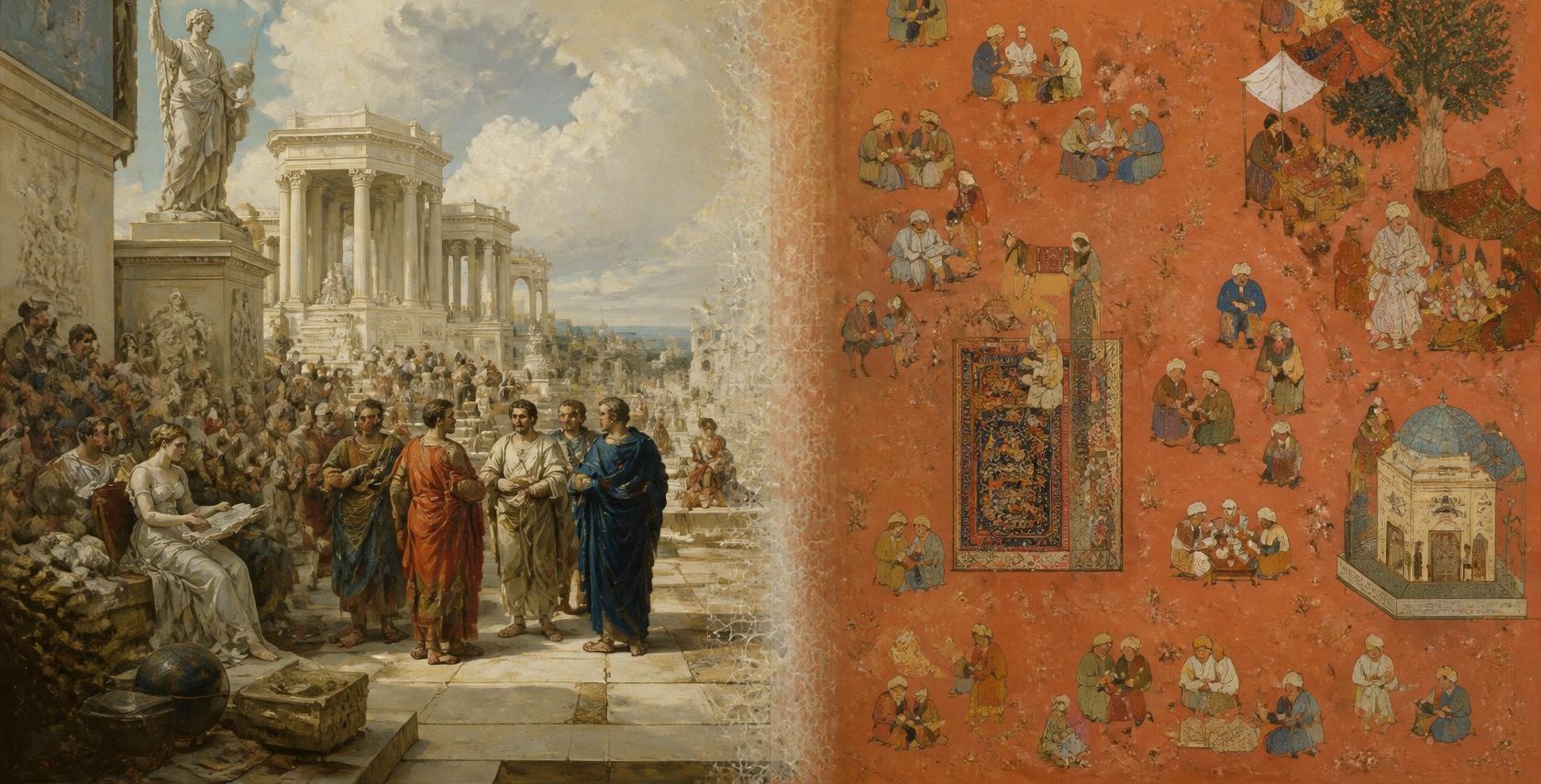
* Importance: Addressing the transformation of regimes of seeing in miniature art, this study analyses in depth the ontological distinction between Western linear perspective and the East's perspective of importance, through the portraits of Sultan Mehmed the Conqueror. While linear perspective fixes the gaze on a single centre and reduces the world to a human-centred mathematical order, the way of seeing that forms the basis of the miniature positions objects according to their value in the world of meaning rather than their physical location. In this context, the Fatih portraits by Nakkaş Sinan Bey and by Gentile Bellini represent not only the styles of two different artists, but also the encounter of two opposing worldviews and cultural techniques.
The perspective of importance applied in the traditional miniature determines the sizes and placements of figures not by their distance from the viewer but by their hierarchical power within the story. This is the result of the artist setting aside physical reality to seek a “divine or mental truth.” The analyses made of the Fatih portraits in particular show that the manner of representing the sultan is not merely a search for likeness, but also how a language of power is constructed through the ornaments, colours and postural forms used. While the Renaissance concern for depth and volume is prominent in Bellini's portrait, in depictions nourished by the local tradition the planar structure and symbolic details of the figure emphasise his timeless and transcendent identity.
This academic grounding proves that in the process of renewing tradition, the miniature is not a static method of copying but rather has a flexible structure capable of accommodating different regimes of seeing. Through the dialogue established between these two different points of view, the artist combines the visual codes of the past with semiotics, a modern method of analysis. Thus the Fatih portraits go beyond being mere historical images and become the most concrete indicators of the aesthetic and philosophical bridge between East and West. This analysis reveals, with theoretical depth, how tradition can be used as a reference point in contemporary art practices and how it can be re-signified within a post-modern structure.
Click to read the article
* DOI / Source: https://doi.org/10.25306/skad.544649
https://izlik.org/JA94CL96UZ
Related Posts
Orientalism, Postcolonialism and Art
12 Aug 2026
